📐 London Geometry and Machine Learning (LOGML) Summer School 2026

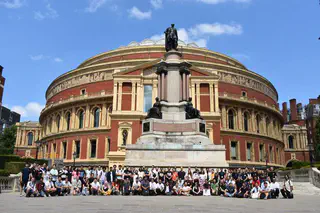 LOGML 2026 at Royal Albert Hall, London – leaders in geometric deep learning and machine learning.
I had the privilege to attend the London Geometry and Machine Learning (LOGML) Summer School 2026 held at Imperial College London from July 13-17, 2026.
This was my first summer school during my PhD journey, and it was an incredible opportunity to engage with the vibrant community of doctoral students, researchers, and experts working at the intersection of mathematics, geometry, and machine learning.
Program Overview
The summer school featured intensive lectures and tutorials covering:
- Graph Representation Learning - Understanding and learning from graph-structured data
- Learning Graphs from Data - Discovering graph structures from raw data
- Equivariant Machine Learning - Building models that respect symmetries and invariances
- Algebraic Geometry in Deep Learning - Mathematical foundations for neural network design
- Discrete Structures for 3D Geometric Learning - Geometric approaches to 3D data
- Graph Foundation Models - Pre-trained models for graph-based tasks
- Physics-Informed Graph Neural Networks - Incorporating physical priors into GNNs
Key Learnings
I was particularly inspired by lectures from world-leading experts including:
- Xiaowen Dong - Graph signal processing and learning
- Dorina Thanou - Geometric methods in machine learning
- Stefanie Jegelka - Graph neural networks and expressiveness
- Olga Fink - Physics-informed machine learning
Their discussions on mathematical and physical priors in building graphical models, and the integration of AI in physical and health sciences, were enlightening.
Collaborative Project
During the summer school, I had the opportunity to work on a group project exploring:
Canonicalization of 3D Molecular Point Clouds - Collaborating with mentor Snir Hordan, we investigated how symmetry-aware preprocessing can help conventional neural architectures learn from molecular geometry more efficiently.
This work bridges the gap between geometric deep learning theory and practical molecular applications.
Key Takeaways
- Deepened understanding of geometric and topological approaches in deep learning
- Networked with talented researchers from institutions worldwide
- Gained hands-on experience with cutting-edge techniques in equivariant learning
- Explored applications in molecular geometry and 3D learning
- Built connections with mentors and peers in the GDL community
Gratitude
I’m grateful to the LOGML Organizers, especially Dr. Lennart Bastian, the speakers, mentors, and fellow participants for creating such an intellectually stimulating and collaborative environment.
Learn More
For more information about LOGML:

I’m a PhD student at the Department of Computer Science, University of Luxembourg, deep diving into the mathematical foundations of geometrical/topological deep learning. I am currently working under Professor Jun Pang.
Beyond research, I’m passionate about staying active through gym workouts, climbing, martial arts, and kickboxing. I enjoy reading novels and occasionally play Tabla, a classical Indian percussion instrument.